
Earlier this month, we watched news coverage in horror as a devastating fire tore through a historic building in Glasgow city centre.
It’s desperately sad to see a beautiful building destroyed. This should serve as a sobering reminder of just how quickly a small incident can escalate into a major emergency.
The blaze destroyed Union Corner, a Category B-listed Victorian building dating back to 1851. Union Corner is next to Glasgow’s Central Station, busiest railway hub. The building housed multiple small businesses – including cafés, shops and the vape shop in which the fire started. Within hours, the entire structure had become a gutted shell. The iconic dome collapsed and with it, many small businesses were lost.
Fire: Early Intervention Matters
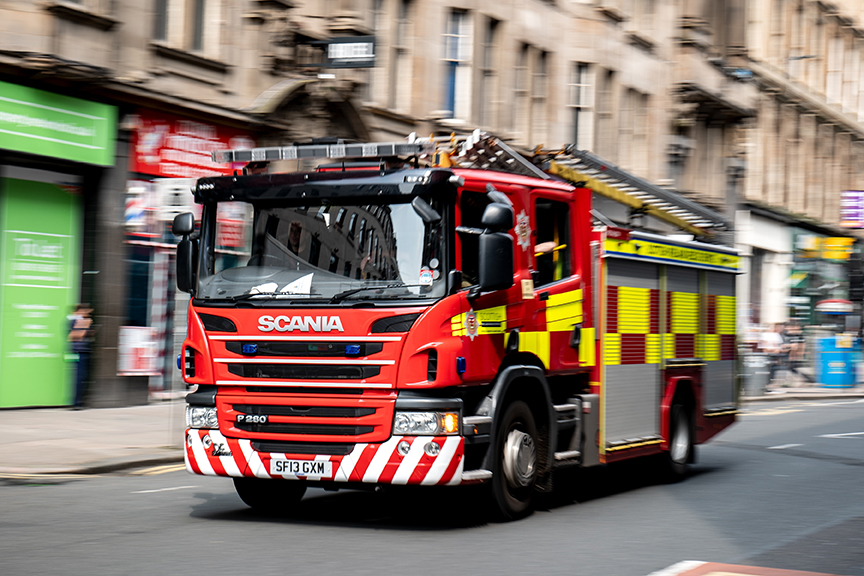
Thankfully, somehow, there were no fatalities reported. However, the fire certainly posed a serious threat to life and nearby infrastructure, forcing the closure of the station and triggering the evacuation of surrounding premises. More than 200 firefighters and 18 fire engines were eventually deployed to control the inferno.
For us fire safety professionals, the incident raises an important question: would early intervention have prevented the disaster? Early intervention being the right fire extinguishers, sited in the right locations, with the staff and nearby occupants trained to use them right. That’s probably a rhetorical question.
How the Glasgow Fire Started
Emergency services responded to a 999 call shortly before 3:46pm on 8 March 2026. A ‘small fire’ was reported inside a ground-floor vape shop in the building on Union Street. Witnesses spoke of hearing ‘an explosion’ before flames began to spread rapidly through the unit and immediate area.
The fire accelerated dramatically in just an hour. It broke through the floors above and spread rapidly through the Victorian building’s internal voids. By evening the blaze had caused partial collapse, including the building’s historic dome.
A Terrifying Risk
The proximity of the building to the bustling hub of Glasgow Central Station created a significant risk scenario. The station would’ve been even busier than average as football’s Old Firm derby, between Glasgow Rangers and Celtic, was played earlier that day. Rail services were stopped and large areas of the city centre were cordoned off while firefighters battled the blaze.
The beautiful building was destroyed, a tragedy in itself. However, firefighters were able to prevent the fire spreading to neighbouring landmarks, including the station and the nearby Grand Central Hotel.
An Historic Building Lost to Fire
Beyond the immediate disruption, there are several businesses who, even if adequately insured, now face huge losses and immense inconvenience. It’s hard to say when, or even if, they’ll be able to trade again. The fire also caused the loss of part of Scotland’s architectural heritage.
Union Corner was so much more than just a commercial property. Built in the mid-19th century, it was part of Glasgow’s historic urban landscape and, lately, became home to numerous independent businesses. The building’s destruction has left business owners devastated, with many losing equipment, stock, and workplaces overnight. Even good insurance won’t cover all the costs and losses incurred.
Local residents and heritage groups have described the loss as ‘heartbreaking,’ with some comparing the scene to wartime devastation, due to the scale of damage. Historic buildings invariably present distinct fire risks. Their age, construction methods, and internal layouts often allow flames to travel rapidly through cavities, voids and timber structures. Once a fire reaches this stage, even a huge firefighting response can struggle to save the building.
How Does a ‘Small Fire’ Spread?
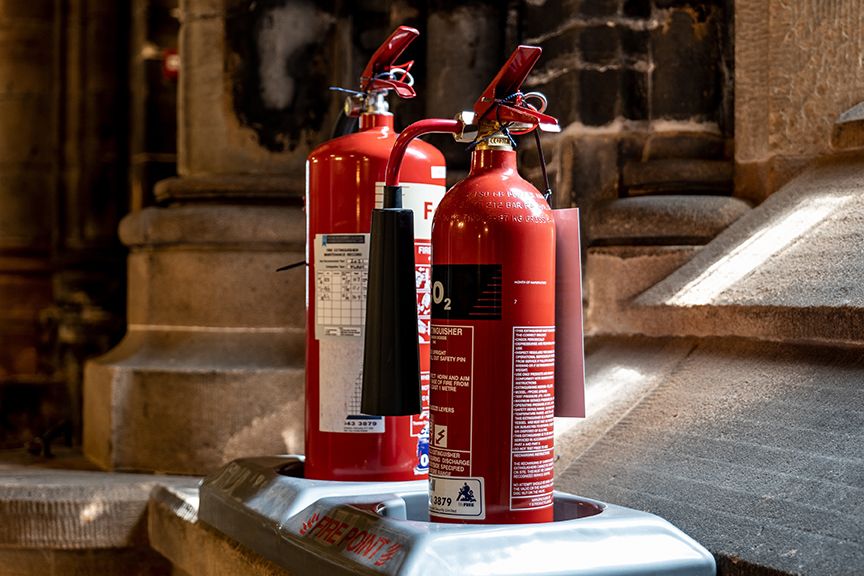
A crucial detail emerged from reports, which highlights the critical importance of early fire response, especially siting suitable fire extinguishers. Many witnesses report that a passer-by attempted to tackle the initial fire. He used a fire extinguisher from a nearby premises, after seeing flames inside the shop.
His well-meaning and heroic attempt sadly came too late to prevent the fire escalating. It also begs the question was there a suitable fire extinguisher in the actual shop? In many workplace environments, a trained staff member, with immediate access to the correct extinguisher, can tackle small fires safely before they develop into full-scale incidents.
This is precisely why fire extinguishers remain a fundamental component of workplace fire safety.
The Role of Fire Extinguishers: “Golden Minutes”
The first few minutes of a fire are critical. That’s from a professional fire prevention point of view – and a personal or residential one. Most workplace fires start small. Fires in business premises are often due to electrical faults, overheating equipment, or human error. At this early stage, they are frequently manageable with a fire extinguisher.
In the fire service it’s often said that the first two minutes decide everything. If a trained person tackles the fire safely with the correct extinguisher, a disaster can be averted before the fire brigade even arrives. Imagine, something so simple and so accessible could’ve stopped the destruction in Glasgow.
Without that early intervention of correct fire extinguishers, fires grow exponentially. Heat increases rapidly, materials ignite, and flashover becomes a real risk. ‘Flashover’ is the term given to the stage of a fire when everything within a space is at ignition temperature. It’s every bit as dangerous and frightening as it sounds. Flame breaks out almost at once over the surface of all objects within the space, and the immediate vicinity becomes ‘non-survivable.’
In dense city centre buildings like the Glasgow site, this escalation can be incredibly fast.
Fire Risk in Mixed-Use Buildings
The Union Street building contained a mixture of retail, hospitality, and service businesses. That’s a common scenario in many town and city centres.
Mixed-use buildings bring particular fire safety challenges:
- High footfall and public access
- Different business activities and hazards
- Shared structures and escape routes
- Older construction with hidden voids
When a fire begins in one unit, it can quickly affect neighbouring businesses and floors above. This is why comprehensive fire risk assessments, staff training, and correctly positioned extinguishers are essential in such premises.
Firefighter Response and Operational Challenges
While early intervention is critical, the Glasgow incident also highlights the immense challenge firefighters face when dealing with large urban fires. At the height of the incident, specialist resources were deployed, including high-volume pumps drawing water from the River Clyde. However, reports also revealed that the city’s only high-reach ladder appliance was unavailable at the time, so a unit came from another town.
Even with significant resources, once a fire has spread through a large structure, the focus often shifts from extinguishment to containment and protecting neighbouring buildings. This is exactly what happened in Glasgow.
Lessons – and Warnings – for Businesses
The Glasgow fire demonstrates several important lessons for business owners and property managers:
- Small fires CAN and WILL become catastrophic if not dealt with properly. Many major building fires start with relatively minor ignition sources.
- Early action is critical: Trained staff using the correct extinguisher may stop a fire before it spreads.
- Extinguishers MUST be accessible. They should be correctly located, maintained and appropriate for the risks present. They should also be serviced correctly.
- Training saves lives and property – employees should know when and how to use extinguishers safely.
- Fire risk assessments are essential as they identify hazards and ensure safety measures are in place.
Preventing the Next Disaster
Thankfully – and almost unbelievably – the Glasgow incident resulted in no reported fatalities or even injuries. Yes, it could’ve been far worse – but the loss of an irreplaceable, historic building is tragic. That, and the losses incurred by dozens of businesses is a stark reminder of how devastating fires can be. Fires destroy – economically, culturally and socially.
In many cases, the difference between a minor incident and a city-centre inferno comes down to the first line of defence: early detection, proper equipment, and trained people. Fire extinguishers are not a substitute for the fire service. They are often the tool that stops a small fire becoming a major emergency.
And, as this incident shows, those early moments matter.